This worksheet covers finding x- and y-intercepts across a range of function types, from GCSE-level polynomials through to A-Level rational, logarithmic, and trigonometric functions. Exercises are graded by difficulty with full worked solutions.
By the end of this worksheet, you should be able to:
- Find x- and y-intercepts of polynomial, rational, exponential, logarithmic, and trigonometric functions
- Recognise when a function has no x-intercept or no y-intercept, and explain why
- Use factorisation, the quadratic formula, and algebraic manipulation to solve for intercepts
- Interpret intercepts in context and relate them to the graph of a function


Theory Recap - X and Y Intercepts
The intercepts of a function are the points where its graph crosses (or touches) the coordinate axes.
| Intercept | What it means | How to find it |
|---|---|---|
| y-intercept | Where the graph crosses the y-axis | Set  and evaluate and evaluate  |
| x-intercept(s) | Where the graph crosses or touches the x-axis (also called roots or zeros) | Set  and solve for and solve for  |
A function can have zero, one, or many x-intercepts, but a function (as opposed to a relation) can have at most one y-intercept — because each input gives exactly one output.
• Students often swap the method — setting  to find the y-intercept and to find the x-intercept. Remember: y-intercept means set x to zero.
• Not all functions are defined at . For example,  and
and  have no y-intercept because they are undefined at .
• The equation  has no solution, since
  for all real . Exponential functions of the form
  only have an x-intercept when
  .
.
Worked Examples
Find the x- and y-intercepts of:

Function:
y-intercept — set :

x-intercept — set :

y-intercept:  | x-intercept:
Find the x- and y-intercepts of:

Function:
y-intercept — set :

x-intercepts — set and factorise:

So  or
or  .
.
y-intercept:  | x-intercepts: and
Find the x- and y-intercepts of:

Function:
y-intercept — set :

x-intercept — set and factorise:

The discriminant is zero, so the parabola touches the x-axis at exactly one point (a repeated root). The graph does not cross — it is tangent to the x-axis at .
y-intercept:  | x-intercept: — repeated root (tangent point)
Find the x- and y-intercepts of:

Function:
y-intercept — set  :
:

x-intercepts — check the discriminant:

Since  | x-intercepts: none (discriminant is negative)
Find the x- and y-intercepts of:

Function:
y-intercept — set :

The y-intercept is the origin.
x-intercepts — set and factorise:

So , , or  .
.
y-intercept:  | x-intercepts:
  , , and
Find the x- and y-intercepts of:

Function: (domain:  )
)
y-intercept — set :
 is outside the domain (), so there is no y-intercept.
x-intercept — set :

y-intercept: none (function undefined for  x <3[/latex]) | x-intercept: [latex](7,\ 0)[/latex]
Find the x- and y-intercepts (if they exist) of:
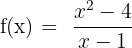
Function: (undefined at  )
)
y-intercept — set :

x-intercepts — set the numerator equal to zero (provided the denominator is non-zero at those points):

Check: neither nor makes the denominator zero, so both are valid intercepts.
y-intercept: | x-intercepts: and
Note: For a rational function  , the x-intercepts come from solving
  , but only where
  . If both
  and
and  at the same point, there is a hole in the graph rather than an intercept.
Find the x- and y-intercepts (if they exist) of:

Function:
y-intercept — set :

x-intercept — set :

y-intercept:  | x-intercept:
Find the x- and y-intercepts (if they exist) of:

Function: (domain:  )
)
y-intercept — set :

x-intercept — set :

y-intercept:  | x-intercept:
Note:  when the argument equals 1 (since
  ), not when it equals 0. A common error is to write
  — this gives the boundary of the domain, not the intercept.
Find the x- and y-intercepts of:

Function:
y-intercept — set :

x-intercepts — set :

The modulus equation gives two cases:


y-intercept:  | x-intercepts:
  and
and
Find all x-intercepts of the function on the interval  , and state the y-intercept:

Function: on
y-intercept — set :

x-intercepts — set :

The principal value is  . Since sine is also positive in the second quadrant:
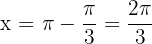
Both solutions lie within .
y-intercept:  | x-intercepts:
  and
and 
Find the x- and y-intercepts (if they exist) of:
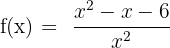
Function: (undefined at )
y-intercept — set :
The denominator is  when , so the function is undefined at . There is no y-intercept.
x-intercepts — set the numerator equal to zero:

Check: neither value makes the denominator zero, so both are valid.
y-intercept: none (function undefined at ) | x-intercepts: and
Find the x- and y-intercepts (if they exist) of:

Function: (domain:  )
)
y-intercept — set :
At , the argument of the logarithm is  :
:

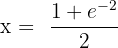
Check: 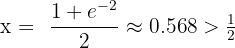 , so this lies within the domain. ✓
y-intercept: none | x-intercept: 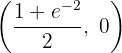
A curve is defined parametrically by:

Find the coordinates of all points where the curve crosses the x-axis and the y-axis.
Curve: 
x-axis crossings — find values of  where , then substitute into :

So  . Substitute each into
  :
:

The curve crosses the x-axis at  and touches it at — note both
  and
and  give the same Cartesian point, meaning the curve passes through the origin twice (a self-intersection on the x-axis).
y-axis crossings — find values of where , then substitute into  :
:


Both values give , confirming the single point is where the curve meets the y-axis.
x-axis crossings: and | y-intercept: — the origin (self-intersection point)
Note: With parametric curves, always work in the parameter — find values first, then convert back to  . Different values of can produce the same Cartesian point; this signals a self-intersection and is worth noting explicitly in an exam answer.
A curve is defined implicitly by:

Find the x- and y-intercepts of the curve.
Curve:
x-intercepts — set and solve:

y-intercepts — set and solve:

Since  has no real solutions, the curve does not cross the y-axis.
This makes geometric sense: the curve is a hyperbola-like conic that opens in the horizontal direction and does not reach the y-axis for real .
x-intercepts:  and
and  | y-intercepts: none (gives , no real solutions)
Note: For implicit curves, intercepts are found by the same rules — set the other variable to zero and solve — but the resulting equation may be quadratic or harder. Always check whether solutions are real before claiming an intercept exists.
Find the x- and y-intercepts (if they exist) of:

Function: 
y-intercept — set :

The y-intercept is the origin .
x-intercepts — set :

Step 1 — Factor rather than taking logs immediately. Write  :
:

Step 2 — Solve each factor. Since  for all real , it can never equal zero. So:

The only x-intercept is at , confirming it coincides with the y-intercept — the curve passes through the origin and that is its only intercept on either axis.
y-intercept: | x-intercept: — the origin is the only intercept on both axes
⚠ Common Mistake: Taking  of both sides of
  and writing
  gives the correct answer here, but misses the factorisation structure entirely and would fail on similar questions where
  is not a common factor. Always try to factorise first when the equation involves sums or differences of exponentials.
Key Techniques For Solving X and Y Intercept Problems
. To find the x-intercepts, set . Always check these rules before starting. to determine how many real roots exist before attempting to solve (Exercises 2, 3, 4, 5). is in the domain before claiming a y-intercept (Exercises 7, 12).
 and
and  . Always check the domain of a logarithmic function — it has a y-intercept only if is in the domain (Exercises 8, 9, 13).
Always check the domain before claiming an intercept exists. Examiners regularly award marks for correctly stating "no y-intercept because the function is undefined at " — a one-line explanation is enough for full credit.
Summarise with AI:
Did you like this article? Rate it!

 Loading...
I get it somehow, there are others who are unfamiliar and I have a hard time with it but it’s okay that I get it.
Thanks for sharing your thoughts! It’s completely normal to find some parts unfamiliar or more difficult than others. The important thing is that you’re making progress and understanding more as you practise. Keep going! 😊
At least I understood some of it, but there are others that I’m confused about and have a hard time understanding, but I get it.
Thanks for sharing! It’s great that you’ve understood some of it already. Don’t worry if a few parts are still confusing — keep practising and take your time with the trickier sections. You’ll get there! 😊
The lesson was a little difficult for me, especially the word problems, but the examples helped me understand it better.
Thanks for your feedback! Word problems can definitely be tricky, so we’re glad the examples helped make the lesson clearer. Keep practising — it gets easier with time! 😊
Thankyouuu po