A list of numbers can be arranged in an arithmetic, geometric, Fibonacci, or harmonic sequence. In this article, you will learn what is an arithmetic sequence, how to calculate its nth terms, and how to find the sum of the sequence up to the n number of terms.


What is an Arithmetic Sequence?
An arithmetic sequence represents the series of numbers arranged in a specific pattern. If the numbers are arranged in an arithmetic sequence, and you take any number in the list and subtract its predecessor, the resulting number will always be the same. This number that you obtain after subtracting the previous number from the next number is known as a common difference and is denoted by d. The common difference is used to determine the next terms in the series. You just add the common difference to any term in the list to get the next term. An arithmetic sequence can be:
- Increasing: If the common difference is positive, then we say that the sequence is increasing.
- Decreasing: If the common difference is negative, then we say that the sequence is decreasing.
An arithmetic sequence is also known as arithmetic progression. We can summarize the above information about the arithmetic sequence in this way:
A list of numbers arranged in such a way that the difference between two successive terms is a constant d is known as an arithmetic sequence
Example 2
Find the 50th term of the following arithmetic sequence and also calculate the sum of the first 50 terms of the sequence.
28, 32, 36, 40, ...
Solution
We have to find the 50th term of the sequence. The formula for computing the nth term of the sequence is given below:

First, we will find the common difference (d) of the sequence. Take any two consecutive terms in the sequence and take the difference between the successor and the predecessor. Let suppose we take the first and second, and second and third terms:
32 - 28 = 36 - 32 = 4
The difference is constant, i.e. 4. Hence, it is a common difference of the sequence. Note that this common difference is positive, hence we can say that the sequence is increasing. Substitute

and n = 50 in the above formula to get the 50th term.




Hence, the 50nd term of the sequence is 224.
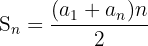
Substitute

,

, and

in the above formula to get the sum:
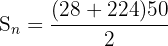


Hence, the sum of the sequence upto the 50th term is 6300.
Example 3
Find the 48th term of the following arithmetic sequence and also calculate the sum of the first 48 terms of the sequence.
2048, 2040, 2032, 2028, ....
Solution
We have to find the 48th term of the sequence. The formula for computing the nth term of the sequence is given below:
First, we will find the common difference (d) of the sequence. Take any two consecutive terms in the sequence and take the difference between the successor and the predecessor. Let suppose we take the first and second, and second and third terms:
2048 - 2040 = 2032 - 2040 = -4
The difference is constant, i.e. -4. Hence, it is a common difference of the sequence. Note that this common difference is negative, hence we can say that the sequence is decreasing. Substitute

and n = 48 in the above formula to get the 48th term.




Hence, the 48th term of the sequence is 1860.
Substitute

,

, and

in the above formula to get the sum:
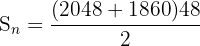


Hence, the sum of the sequence upto the 48th term is 93792. Find the 35th term of the following arithmetic sequence and also calculate the sum of the first 35 terms of the sequence. 98, 81, 64, 47,.... We have to find the 35th term of the sequence. The formula for computing the nth term of the sequence is given below: First, we will find the common difference (d) of the sequence. Take any two consecutive terms in the sequence and take the difference between the successor and the predecessor. Let suppose we take the first and second, and second and third terms: 81 - 98 = 64 - 81 = -17 The difference is constant, i.e. -17. Hence, it is a common difference of the sequence. Note that this common difference is negative, hence we can say that the sequence is decreasing. Substitute and n = 35 in the above formula to get the 35th term. Hence, the 35th term of the sequence is -480. Example 4
Solution





Substitute

,

, and

in the above formula to get the sum:
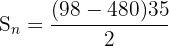
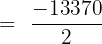

Hence, the sum of the sequence upto the 35th term is -6685.
Summarise with AI:
Did you like this article? Rate it!


 Loading...
I get it somehow, there are others who are unfamiliar and I have a hard time with it but it’s okay that I get it.
Thanks for sharing your thoughts! It’s completely normal to find some parts unfamiliar or more difficult than others. The important thing is that you’re making progress and understanding more as you practise. Keep going! 😊
At least I understood some of it, but there are others that I’m confused about and have a hard time understanding, but I get it.
Thanks for sharing! It’s great that you’ve understood some of it already. Don’t worry if a few parts are still confusing — keep practising and take your time with the trickier sections. You’ll get there! 😊
The lesson was a little difficult for me, especially the word problems, but the examples helped me understand it better.
Thanks for your feedback! Word problems can definitely be tricky, so we’re glad the examples helped make the lesson clearer. Keep practising — it gets easier with time! 😊
Thankyouuu po