


Pattern
In calculus, many of the questions that you will encounter will ask you a question that relates to patterns in the function or numbers. In order to start discussing what ‘nth’ means, we should define a pattern.
A pattern is any sort of trend in a list of numbers, objects and more. Let’s take a look at some examples of patterns in math.
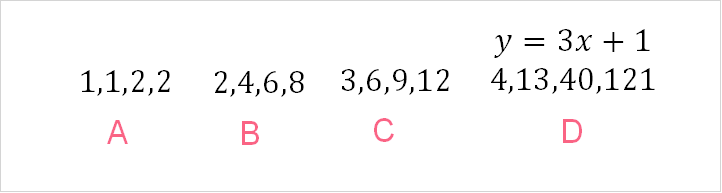
| A | Repetition |
| B | Even numbers |
| C | Odd numbers |
| D | Functions |
Sequence
The most common type of pattern in math is called a sequence. A sequence is a list of numbers that can be either finite or infinite.
| Infinite | Goes on forever | [1,5,9,.....) |
| Finite | Ends at a known number | [1,5,9,13] |
There are two special properties about sequences that go hand in hand. They can be seen below.
| Order | The order is important, you can’t switch up the order | [1,5,9,13] is not the same as [13,9,5,1] |
| Defined rule | A rule is defined for how to get each successive number | Rule for [1,5,9,13] is  Rule for [13,9,5,1] is  |
As you can see, sequences have specific notation that we can use to define the rules they use. These rules can also be called functions because they take one number as input and give an output. 
 | The number at position n | The input |
 | The number at position n+1 | The output |
We pick 1 as a starting number. Because it is the first number in our list, it is located in position number 1. 
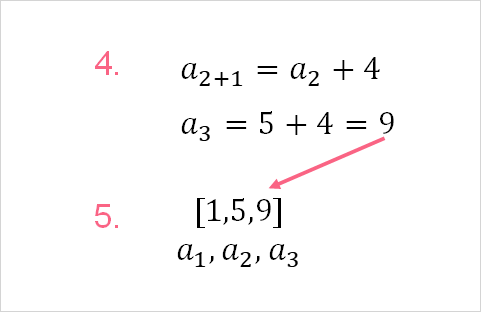
The nth number is defined as the number n of any sequence. In this case, it would be
, which can be anything:

,

,

, etc.
Arithmetic Sequence
There are many special types of sequences. Arithmetic sequences are a special type of sequence. It is defined as a sequence where every number has the same constant added to it. We already saw an example of this in the section before:
| Definition | Notation | Example | |
| Arithmetic Sequence | The same constant is added to every successive number |  | |
One common problem you’ll face is being asked to find the rule for a given sequence. One simple way to find the rule for a sequence is to first test whether a sequence is an arithmetic sequence.
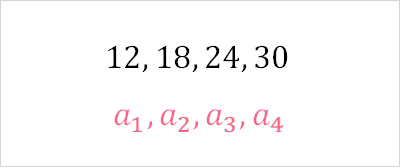
Using the sequence above, let’s test whether it is an arithmetic sequence. You can do this by the following steps.
| Step1 | We need to take every number and subtract the one before it to see if they all result in the same constant |  |
| Step2 |  | A |
| Step3 |  | B |
| Step4 |  | C |
| Step5 | Do all numbers match? | Does x = y = z ? |

Geometric Sequence
A geometric series is similar to an arithmetic sequence. The main difference is that, instead of adding a constant, we multiply each number by the same constant.
| Definition | Notation | Example | |
| Geometric Sequence | The same constant is multiplied to every successive number |  |  |
Now, instead of adding four, we multiply each nth number and 4. Let’s take a look at the first four numbers of this sequence starting with the number 3.

As you can see, from one number to the next, we have 4 multiplied. When you want to find out whether you have a geometric series or not, simply divide each successive number by each other.
 |  | 4 |
 |  | 4 |
 |  | 4 |
Power
Powers define the number of times we multiply a number by itself. A power is also called a degree. The form that it takes is the following: 
| 1 |  | 3*3 |
| 2 |  | 3*3*x |
| 3 |  | 3*3*x*x*x |
Square Root
You can think of a square root as the opposite of a power. The square root, or the root, of any function works to ‘undo’ a power. For example, let’s take the square root of 4. 

Polynomial Function
When we talk about polynomial functions and an ‘nth’ term, we usually mean the number of the observations. Say we have the following polynomial:

We get this formula from the following coordinates:
| x | y |
| 3 | 19 |
| 5 | 29 |
| 7 | 39 |
| 8 | 44 |
| 9 | 49 |
| 10 | 54 |
| 14 | 74 |
The nth value of x means that this value applies to any value of x within this range. For example, we can take the value of 2 for x and it results in: 14.
Summarise with AI:
Did you like this article? Rate it!


 Loading...
I get it somehow, there are others who are unfamiliar and I have a hard time with it but it’s okay that I get it.
Thanks for sharing your thoughts! It’s completely normal to find some parts unfamiliar or more difficult than others. The important thing is that you’re making progress and understanding more as you practise. Keep going! 😊
At least I understood some of it, but there are others that I’m confused about and have a hard time understanding, but I get it.
Thanks for sharing! It’s great that you’ve understood some of it already. Don’t worry if a few parts are still confusing — keep practising and take your time with the trickier sections. You’ll get there! 😊
The lesson was a little difficult for me, especially the word problems, but the examples helped me understand it better.
Thanks for your feedback! Word problems can definitely be tricky, so we’re glad the examples helped make the lesson clearer. Keep practising — it gets easier with time! 😊
Thankyouuu po