Whether it is measuring the intensity of an earthquake on the Richter scale or the acidity of a solution via pH, logarithms are the mathematical tools that help us manage exponential scales. At its core, a logarithmic function is the inverse of an exponential function. While an exponent tells us what a number becomes when raised to a power, a logarithm reveals what that power was in the first place. For A-Level students, mastering these functions is the key to solving equations where the unknown is tucked away in a power.


Theory
Defining the Logarithm
A logarithm answers the question: "To what power must I raise base a to get the value x?" The logarithmic function is written as:
This statement is logically equivalent to the exponential form:
In this relationship:
- a is the base (where a > 0 and a ≠ 1).
- x is the argument (the input, where x > 0).
- y is the exponent (the output).
The Natural Logarithm
In higher mathematics, we often use a special irrational constant called Euler’s number, denoted by e (approx 2.718). When a logarithm uses e as its base, it is called the natural logarithm and is written as:
This is simply shorthand for:
Graphing Logarithmic Functions
The logarithmic function is a reflection of the exponential function in the line y = x. This visual symmetry highlights their relationship as inverse operations.
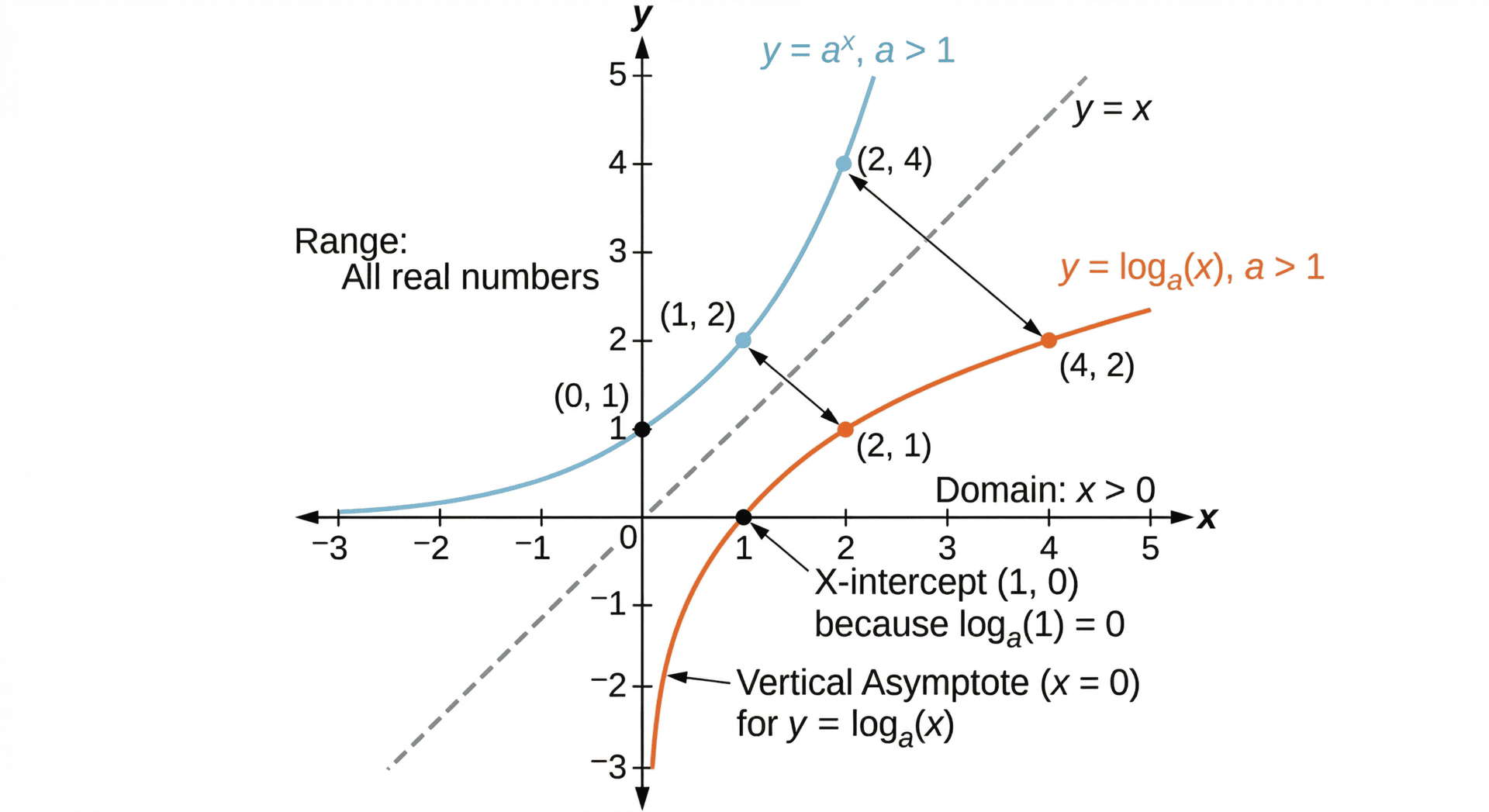
Key features of the graph (where a > 1):
- Vertical Asymptote: The graph approaches but never touches the y-axis (x = 0).
- X-intercept: The curve always passes through (1, 0) because for any base:
- Domain: x > 0 (You cannot take the log of a negative number or zero).
- Range: All real numbers (-∞ < y < ∞).
Logarithmic Data Trends
To understand how quickly the input must grow to increase the output, observe the base-10 common log:
| x | y = log10(x) |
|---|---|
| 1 | 0 |
| 10 | 1 |
| 100 | 2 |
| 1000 | 3 |
| 10000 | 4 |
Worked Example
Problem: Solve for x in the equation
Step 1: Divide both sides by 3 to isolate the log.
Step 2: Convert the logarithmic equation into its exponential equivalent.
Step 3: Calculate the final value.
Practice Questions & Solutions
Find the value of x for the following equation: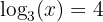
Convert to exponential form.
Calculate the power of 3.
Simplify the expression involving the natural logarithm:
The natural log and the exponential function are inverses.
Therefore: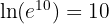
Solve for y in the exponential equation:
Rewrite as a logarithm.
Identify the power of 5 that equals 125.

Solve for x in the following equation:
Rewrite the logarithmic equation in its exponential form.
To find x, calculate the cube root of 64.

Evaluate the following expression using the laws of logarithms:
Apply the quotient rule for logarithms.
Substitute the given values into the formula.
Simplify the fraction inside the logarithm.
Determine the power to which 2 must be raised to equal 16.

Summarise with AI:
Did you like this article? Rate it!


 Loading...
I get it somehow, there are others who are unfamiliar and I have a hard time with it but it’s okay that I get it.
Thanks for sharing your thoughts! It’s completely normal to find some parts unfamiliar or more difficult than others. The important thing is that you’re making progress and understanding more as you practise. Keep going! 😊
At least I understood some of it, but there are others that I’m confused about and have a hard time understanding, but I get it.
Thanks for sharing! It’s great that you’ve understood some of it already. Don’t worry if a few parts are still confusing — keep practising and take your time with the trickier sections. You’ll get there! 😊
The lesson was a little difficult for me, especially the word problems, but the examples helped me understand it better.
Thanks for your feedback! Word problems can definitely be tricky, so we’re glad the examples helped make the lesson clearer. Keep practising — it gets easier with time! 😊
Thankyouuu po