In algebraic modeling, functions can take many forms depending on how variables interact. When one polynomial expression is divided by another, it forms a rational function. These functions exhibit fascinating graphical properties, such as sudden breaks, structural boundaries, and curves known as hyperbolas. Mastering rational functions is a core component of GCSE Higher extension and A-Level Mathematics, providing vital skills for analyzing algebraic fractions and graph theory.


Theory
What is a Rational Function?
A rational function is defined mathematically as the quotient of two polynomial functions. It can be written in the general form:
Where P(x) and Q(x) are polynomials, and the denominator Q(x) ≠ 0. If Q(x) is a constant, such as 1, the rational function simplifies into a standard polynomial. Therefore, all polynomial functions are technically a subcategory of rational functions.
Domain Restrictions
The foundational rule of mathematics dictates that division by zero is undefined. Consequently, a rational function cannot accept any input value for x that causes its denominator to equal zero. The domain of a rational function consists of all real numbers except for the specific roots of the denominator equation Q(x) = 0.
For example, consider the base reciprocal function:
If x = 0, the output climbs to infinity, creating a critical break in the graph. Thus, the domain restriction is x ≠ 0.
Asymptotes of a Hyperbola
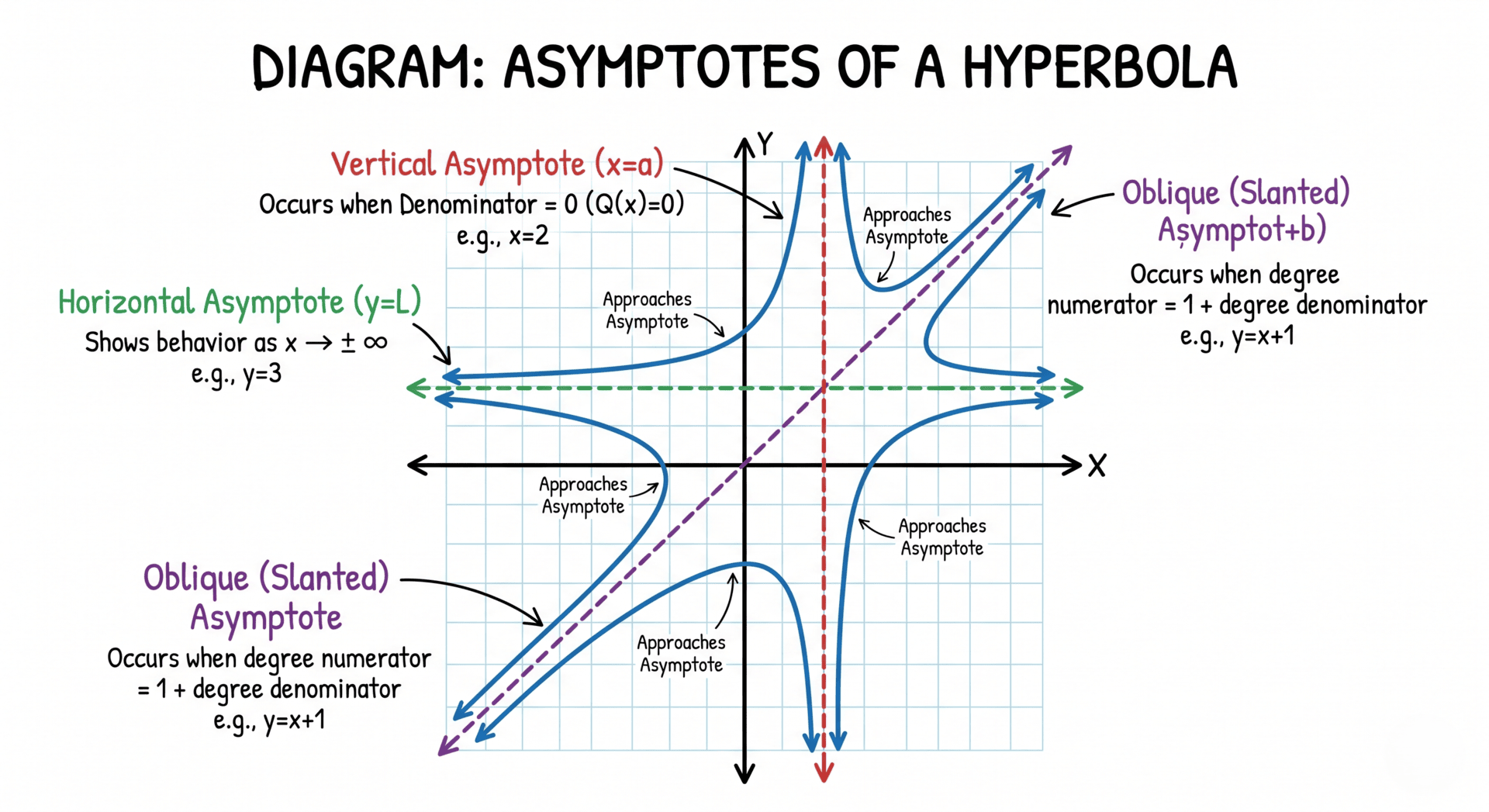
The characteristic graph of a simple rational function is a hyperbola. As the graph approaches an undefined point, the curve bends sharply, tracking alongside an imaginary boundary line known as an asymptote. The curve gets infinitely close to this line but never touches or crosses it. There are three primary types of asymptotes:
- Vertical Asymptotes: Occur at the x-values where the denominator is zero (Q(x) = 0).
- Horizontal Asymptotes: Show the behavior of the graph as x approaches positive or negative infinity.
- Oblique (Slanted) Asymptotes: Occur when the degree of the numerator polynomial is exactly one higher than the degree of the denominator polynomial.
Transformations of Hyperbolas
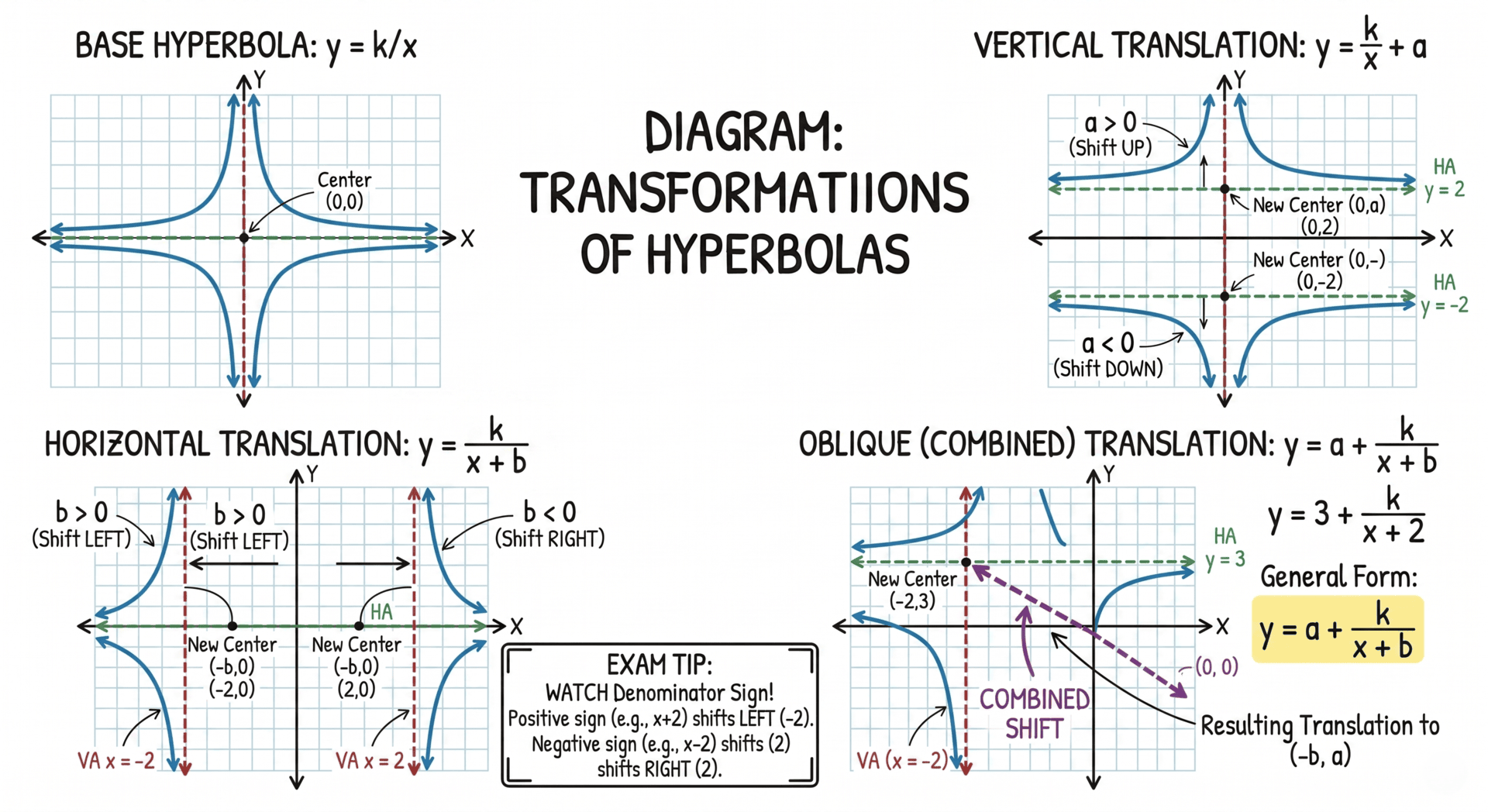
The base hyperbola:
has its center at the origin (0, 0), where its vertical asymptote (x = 0) and horizontal asymptote (y = 0) intersect. We can shift this curve across the coordinate plane using standard geometric transformations.
1. Vertical Translation
Adding or subtracting a constant outside the fraction shifts the graph vertically up or down. The transformed equation is:
If a > 0, the curve and its horizontal asymptote shift upwards by "a" units. The new center of the hyperbola becomes (0, a).
2. Horizontal Translation
Modifying the input variable within the denominator shifts the graph horizontally left or right. The transformed equation is:
If b > 0, the curve shifts to the left by "b" units because the undefined point now occurs where x + b = 0, meaning x = -b. The new center of the hyperbola is (-b, 0).
Exam Tip: Watch out for the sign in the denominator. A positive sign shifts the graph in the negative x-direction, while a negative sign shifts it in the positive x-direction.
3. Oblique (Combined) Translation
When horizontal and vertical translations occur simultaneously, the hyperbola undergoes a combined shift parallel to both axes. The general transformed equation is written as:
Under this condition, the vertical asymptote shifts to x = -b and the horizontal asymptote shifts to y = a. The intersection of these asymptotes, which defines the center of the hyperbola, moves to the coordinate point (-b, a).
Worked Example
Problem: Analyze the rational function given by the equation:
Determine the domain restrictions, state the equations of both asymptotes, and find the coordinates of the center of the hyperbola.
Step-by-step Solution:
- Find the vertical asymptote: Set the denominator equal to zero to discover where the function breaks. x - 2 = 0 implies x = 2 Therefore, the vertical asymptote is the line x = 2.
- Determine the domain: Since the function is undefined at the vertical asymptote, the domain is all real numbers except 2. Domain:
- Find the horizontal asymptote: Look at the constant added outside the fraction block. As x approaches infinity, the fraction term approaches 0, leaving y approaching 5. Therefore, the horizontal asymptote is the line y = 5.
- Identify the center point: The center of the transformed hyperbola is located at the intersection point of the two asymptotes (-b, a). Center = (2, 5)
Practice Questions & Solutions
State the equations of the vertical and horizontal asymptotes for the rational function:
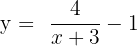
To find the vertical asymptote, set the denominator expression equal to zero:

Solving for x gives the vertical asymptote line:

The horizontal asymptote is given by the constant vertical displacement term outside the fraction block:

Identify the domain restriction for the following rational function:
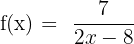
The function becomes undefined when the denominator expression evaluates to zero:

Isolate the variable term to find the excluded x-value:


Therefore, the domain of the function is restricted such that:

Find the coordinates of the center of the hyperbola defined by the equation:
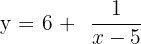
Identify the horizontal shift from the denominator to find the x-coordinate of the center:

Identify the vertical shift from the constant term to find the y-coordinate of the center:

Combine these values to state the coordinate pairs for the center of the hyperbola:

A hyperbola has its center located at the coordinate point below:

If the scale factor k equals 1, construct its rational equation.
The general structural form for a translated hyperbola is given by:
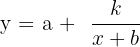
The center coordinate maps directly to the tracking parameters:

This reveals the values for our constants:


Substitute these parameters along with k equals 1 into the general form:
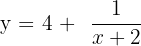
An advanced linear rational function is written as:
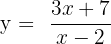
Convert this via algebraic division into the form below to determine its horizontal asymptote:
Rewrite the numerator expression so that it contains a matching multiple of the denominator:

Simplify the constant terms in the adjusted numerator:

Split the rational expression into two separate fraction components:
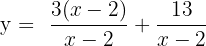
Cancel out the common linear binomial bracket from the first term:
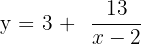
This reveals that as x approaches infinity, the horizontal asymptote is:

Summarise with AI:
Did you like this article? Rate it!

 Loading...
I get it somehow, there are others who are unfamiliar and I have a hard time with it but it’s okay that I get it.
Thanks for sharing your thoughts! It’s completely normal to find some parts unfamiliar or more difficult than others. The important thing is that you’re making progress and understanding more as you practise. Keep going! 😊
At least I understood some of it, but there are others that I’m confused about and have a hard time understanding, but I get it.
Thanks for sharing! It’s great that you’ve understood some of it already. Don’t worry if a few parts are still confusing — keep practising and take your time with the trickier sections. You’ll get there! 😊
The lesson was a little difficult for me, especially the word problems, but the examples helped me understand it better.
Thanks for your feedback! Word problems can definitely be tricky, so we’re glad the examples helped make the lesson clearer. Keep practising — it gets easier with time! 😊
Thankyouuu po