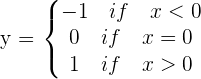
A function can be made with many pieces. For example, after some certain values, the function can change its shape and once it changes its shape that means a change in the equation. The pieces have no specific limit, which means that a function can have many pieces. Since the function has pieces that is why we call it a piecewise function. The piecewise functions are functions defined by different criteria according to the intervals being considered. For example:

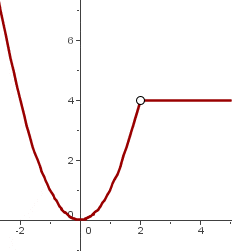
Looking at the above graph, we can conclude a few things. Firstly, we observed that there are two different shapes, which means that we are dealing with two different pieces but within the same domain. Secondly, the breakpoint is

which means that there is a shift in the equation at point

. When
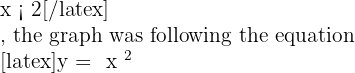
hence you will see the graph of equation

from infinity to
. However, at
, things are about to change, the graph is following the equation

, and since
has no limit, it will continue till infinity. Domain of y:


Floor Function
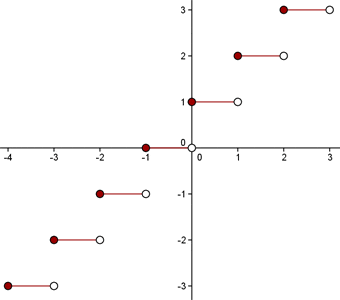
The floor function or greatest integer function gives the largest integer lessthan or equal to x. For example, you are asked to figure out the floor function of  , now you need to find the greatest integer that is less than . Some of you might be thinking the largest integer less than will be
  and that is where you are wrong, we are talking about integers here. Hence, the largest integer which is less than will be
  .
.

 |  |  |  |  |  |  | |
| | | | | | | |
|---|

Ceiling Function
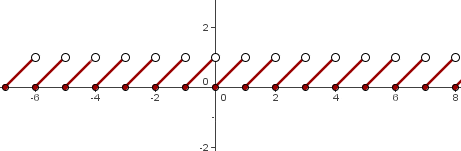
The ceiling function or least integer function gives the smallest integer greater than or equal to x. For example, we will take the above example again but with a small change, this time you were asked to figure out the ceiling function of . The answer is  because is the least integer which is greater than .

| | | | | | | |
| | | | | | | |
|---|


| | | | | | | |
|---|---|---|---|---|---|---|---|
 | | | | | | | |


Summarise with AI:
Did you like this article? Rate it!


 Loading...
I get it somehow, there are others who are unfamiliar and I have a hard time with it but it’s okay that I get it.
Thanks for sharing your thoughts! It’s completely normal to find some parts unfamiliar or more difficult than others. The important thing is that you’re making progress and understanding more as you practise. Keep going! 😊
At least I understood some of it, but there are others that I’m confused about and have a hard time understanding, but I get it.
Thanks for sharing! It’s great that you’ve understood some of it already. Don’t worry if a few parts are still confusing — keep practising and take your time with the trickier sections. You’ll get there! 😊
The lesson was a little difficult for me, especially the word problems, but the examples helped me understand it better.
Thanks for your feedback! Word problems can definitely be tricky, so we’re glad the examples helped make the lesson clearer. Keep practising — it gets easier with time! 😊
Thankyouuu po