


How to Find Maxima and Minima
To find the local maxima and minima of a function  , follow these steps:
Step 1 — Find the first derivative .
.
Step 2 — Set  and solve for
  . These are the stationary points (also called critical points).
Step 3 — Find the second derivative .
.
Step 4 — Classify each stationary point using the second derivative test:
- If
 , the point is a local minimum.
 - If
 , the point is a local maximum.
 - If
 , the test is inconclusive — use the first derivative (sign change) test instead.
Step 5 — Find the y-coordinates by substituting each -value back into the original function .
Worked Problems and Solutions
Exercise 1: 
Solution of Exercise 1
First derivative:

Set :




Second derivative:

Classify:
At  :
:  > 0, so this is a local minimum.
At  :
: 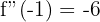 <0, so this is a local maximum.
Y-coordinates:


Conclusion: Local maximum at  . Local minimum at
  .
.
Exercise 2: 
Solution of Exercise 2
First derivative:

Set :


Second derivative:

Classify:
At  :
:  <0, so this is a local maximum.
At  :
:  > 0, so this is a local minimum.
Y-coordinates:


Conclusion: Local maximum at  . Local minimum at
  .
.
Exercise 3: 
Solution of Exercise 3
First derivative:

Set :



Second derivative:

Classify:
At :  <0, so this is a local maximum.
At :  > 0, so this is a local minimum.
At :  > 0, so this is a local minimum.
Y-coordinates:



Conclusion: Local maximum at  . Local minima at
  and
and  .
.
Exercise 4: 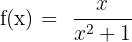
Solution of Exercise 4
First derivative (using the quotient rule):
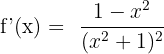
Set :
The denominator is always positive, so set the numerator equal to zero:

Classify using the first derivative sign test:
For : we have  > 0 and
 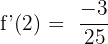 <0. The derivative changes from positive to negative, so this is a local maximum.
For : we have 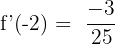 <0 and [latex]f'(0)=1[/latex]> 0. The derivative changes from negative to positive, so this is a local minimum.
Y-coordinates:

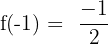
Conclusion: Local maximum at  . Local minimum at
  .
.
Exercise 5: 
Solution of Exercise 5
First derivative:

Set :



Second derivative:

Classify:
At :  <0, so this is a local maximum.
At  :
:  > 0, so this is a local minimum.
Y-coordinates:


Conclusion: Local maximum at  . Local minimum at
  .
.
Exercise 6: 
Solution of Exercise 6
First derivative (using the product rule):

Set :
Since  > 0 for all , we need:

Second derivative:

Classify:
At : 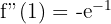 <0, so this is a local maximum.
Y-coordinate:
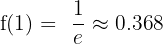
Conclusion: Local maximum at  . There are no local minima.
Exercise 7: 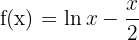
Solution of Exercise 7
Note: The domain is > 0.
First derivative:
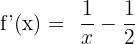
Set :

Second derivative:
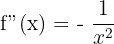
Classify:
At : 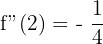 <0, so this is a local maximum.
Y-coordinate:

Conclusion: Local maximum at 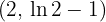 . There are no local minima on the domain > 0.
Summarise with AI:
Did you like this article? Rate it!


 Loading...
I get it somehow, there are others who are unfamiliar and I have a hard time with it but it’s okay that I get it.
Thanks for sharing your thoughts! It’s completely normal to find some parts unfamiliar or more difficult than others. The important thing is that you’re making progress and understanding more as you practise. Keep going! 😊
At least I understood some of it, but there are others that I’m confused about and have a hard time understanding, but I get it.
Thanks for sharing! It’s great that you’ve understood some of it already. Don’t worry if a few parts are still confusing — keep practising and take your time with the trickier sections. You’ll get there! 😊
The lesson was a little difficult for me, especially the word problems, but the examples helped me understand it better.
Thanks for your feedback! Word problems can definitely be tricky, so we’re glad the examples helped make the lesson clearer. Keep practising — it gets easier with time! 😊
Thankyouuu po