Rolle's theorem is a special case of Mean Value Theorem. Both mean value theorem and Rolle's theorem are important concepts of calculus. In this article, we will discuss what is Rolle's theorem in detail along with the relevant examples.


Rolle's Theorem
The definition shows that the function should only be continuous, but also a differentiable function on the interval (a, b). The graphical interpretation of Rolle's Theorem states that there is a point where the tangent is parallel to the x-axis as shown in the graph below:"If a function is continuous on the closed interval [a, b] and differentiable on (a, b) and f(a) = f(b), then, there exists a point, c which is an element of (a, b) such that f'(c) = 0"
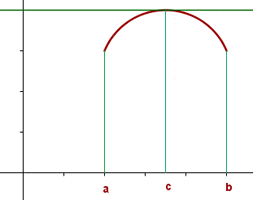
All the following three conditions must be satisfied for the Rolle's theorem to be true:
- f(x) should be continuous on a closed interval [a, b]
- The derivative of f(x) should exist on an open interval (a, b)
- f(a) should be equal to f(b)
The physical interpretation of the Rolle's theorem is straightforward. Consider an object moving in a straight line. After some time, the object moves backwards to reach the starting point. During this time, a moment comes when the instantaneous velocity of an object is zero.
In the next section, we will solve some examples related to Rolle's theorem.
Example 1
Suppose

. Find all values of c in the interval [-2, 0] in such a way that

.
Solution
In the first step, we need to verify if the above function f(x) fulfills all the conditions of Rolle's theorem: a) Since f(x) is a quadratic function, therefore it is continuous at the interval [-2, 0]. b) It can also be differentiated on the open interval (-2, 0) c) We can check whether f(a) = f(b) by substituting -2 and 0 in the function like this:




Hence, f(a) = f(b). This shows that the function satisfies all the three conditions of Rolle's theorem. For computing the point c, we need to find the first-derivative of the function using sum/difference and power rules like this:

Substitute x with c:

According to Rolle's theorem,
:


Hence, for  , the value of c is equal to -1.
Example 2
Suppose

. Find all values of c in the interval [-1, 6] in such a way that
.
Solution
In the first step, we need to verify if the above function f(x) fulfills all the conditions of Rolle's theorem: a) Since f(x) is a quadratic function, therefore it is continuous at the interval [-1, 6]. b) It can also be differentiated on the open interval (-1, 6) c) We can check whether f(a) = f(b) by substituting -1 and 6 in the function like this:





Hence, f(a) = f(b). This shows that the function satisfies all the three conditions of Rolle's theorem. To compute the point c, we need to find the derivative of the function using sum/difference and power rules like this:

Substitute x with c:

According to Rolle's theorem,
:


Hence, for , the value of c is equal to 2.5.
Example 3
Suppose

. Find all values of c in the interval [2, 0] in such a way that
.
Solution
In the first step, we need to verify if the above function f(x) fulfills all the conditions of Rolle's theorem: a) Since f(x) is a quadratic function, therefore it is continuous at the interval [2, 0]. b) It can also be differentiated on the open interval (2, 0) c) We can check whether f(a) = f(b) by substituting 2 and 0 in the function like this:




Hence, f(a) = f(b). This shows that the function satisfies all the three conditions of Rolle's theorem. For computing the point c, we need to find the derivative of the function using sum/difference and power rules like this:

Substitute x with c:

According to Rolle's theorem,
:

The above equation is a quadratic equation of the form  . Here, a = 6, b = 8 and the last constant is equal to 0. We will use the following quadratic formula to find the values of c:


 and

We will discard the negative value

because it is not the part of the closed interval [2,0]. Hence, the only value of c is 0.
Example 4
Suppose

. Find all values of c in the interval [-3, -1] in such a way that
.
Solution
In the first step, we need to verify if the above function f(x) fulfills all the conditions of Rolle's theorem: a) Since f(x) is a quadratic function, therefore it is continuous at the interval [-3, -1]. b) It can also be differentiated on the open interval (-3, -1) c) We can check whether f(a) = f(b) by substituting -3 and -1 in the function like this:




Hence, f(a) = f(b). This shows that the function satisfies all the three conditions of Rolle's theorem. For computing the point c, we need to find the derivative of the function using sum/difference and power rules like this:

Substitute x with c:

According to Rolle's theorem,
:


Hence, for , the value of c is equal to -2.
Example 5
Given the interval [a,b], the function

satisfies the Rolle's theorem. If the known value of a is 0, find the value of b.
Solution
It is given that the function satisfies the Rolle's theorem over an interval [a, b]. It means that it is continuous over this interval and differentiable over an open interval (a, b). It also satisfies the condition

. We only need to find out the value of b. To find the value of b, we will find the roots of the above function:


It is evident that the function has two roots. One is 0 and the other is 2. Hence, the value of b is 2.
Example 6
Suppose

. Find all values of c in the interval [0, 2] in such a way that
.
Solution
In the first step, we need to verify if the above function f(x) fulfills all the conditions of Rolle's theorem: a) Since f(x) is a quadratic function, therefore it is continuous at the interval [0, 2]. b) It can also be differentiated on the open interval (0, 2) c) We can check whether f(a) = f(b) by substituting 0 and 2 in the function like this:



Hence, f(a) = f(b). This shows that the function satisfies all the three conditions of Rolle's theorem. For computing the point c, we need to find the derivative of the function using sum/difference and power rules like this:

Substitute x with c:

According to Rolle's theorem,
:


Hence, for , the value of c is equal to 1.
Summarise with AI:
Did you like this article? Rate it!


 Loading...

I get it somehow, there are others who are unfamiliar and I have a hard time with it but it’s okay that I get it.
Thanks for sharing your thoughts! It’s completely normal to find some parts unfamiliar or more difficult than others. The important thing is that you’re making progress and understanding more as you practise. Keep going! 😊
At least I understood some of it, but there are others that I’m confused about and have a hard time understanding, but I get it.
Thanks for sharing! It’s great that you’ve understood some of it already. Don’t worry if a few parts are still confusing — keep practising and take your time with the trickier sections. You’ll get there! 😊
The lesson was a little difficult for me, especially the word problems, but the examples helped me understand it better.
Thanks for your feedback! Word problems can definitely be tricky, so we’re glad the examples helped make the lesson clearer. Keep practising — it gets easier with time! 😊
Thankyouuu po