





How to Find Maxima and Minima
To find the local maxima and minima of a function  , follow these steps:
Step 1 — Find the first derivative  .
.
Step 2 — Set  and solve for
  . These are the stationary points (also called critical points).
Step 3 — Find the second derivative  .
.
Step 4 — Classify each stationary point using the second derivative test:
- If
 , the point is a local minimum.
 - If
 , the point is a local maximum.
 - If
 , the test is inconclusive — use the first derivative (sign change) test instead.
Step 5 — Find the y-coordinates by substituting each -value back into the original function .
Worked Problems and Solutions
Exercise 1: 
Solution of Exercise 1
First derivative:

Set :




Second derivative:

Classify:
At  :
:  > 0, so this is a local minimum.
At  :
: 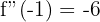 < 0, so this is a local maximum.
Y-coordinates:


Conclusion: Local maximum at  . Local minimum at
  .
.
Exercise 2: 
Solution of Exercise 2
First derivative:

Set :


Second derivative:

Classify:
At  :
:  < 0, so this is a local maximum.
At  :
:  > 0, so this is a local minimum.
Y-coordinates:


Conclusion: Local maximum at  . Local minimum at
  .
.
Exercise 3: 
Solution of Exercise 3
First derivative:

Set :



Second derivative:

Classify:
At :  < 0, so this is a local maximum.
At :  > 0, so this is a local minimum.
At :  > 0, so this is a local minimum.
Y-coordinates:



Conclusion: Local maximum at  . Local minima at
  and
and  .
.
Exercise 4: 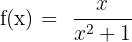
Solution of Exercise 4
First derivative (using the quotient rule):
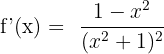
Set :
The denominator is always positive, so set the numerator equal to zero:

Classify using the first derivative sign test:
For : we have  > 0 and
 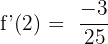 < 0. The derivative changes from positive to negative, so this is a local maximum.
For : we have 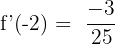 < 0 and [latex]f'(0) = 1[/latex] > 0. The derivative changes from negative to positive, so this is a local minimum.
Y-coordinates:

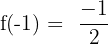
Conclusion: Local maximum at  . Local minimum at
  .
.
Exercise 5: 
Solution of Exercise 5
First derivative:

Set :



Second derivative:

Classify:
At :  < 0, so this is a local maximum.
At  :
:  > 0, so this is a local minimum.
Y-coordinates:


Conclusion: Local maximum at  . Local minimum at
  .
.
Exercise 6: 
Solution of Exercise 6
First derivative (using the product rule):

Set :
Since  > 0 for all , we need:

Second derivative:

Classify:
At : 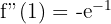 < 0, so this is a local maximum.
Y-coordinate:
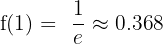
Conclusion: Local maximum at  . There are no local minima.
Exercise 7: 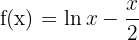
Solution of Exercise 7
Note: The domain is > 0.
First derivative:
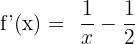
Set :

Second derivative:
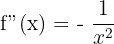
Classify:
At : 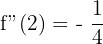 < 0, so this is a local maximum.
Y-coordinate:

Conclusion: Local maximum at 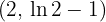 . There are no local minima on the domain > 0.
Summarise with AI:
Did you like this article? Rate it!


 Loading...
Nice to see what you have provided.IT helps me a lo in my engineering mathematics.
i love it mwaaaaa :*